


Portal Tackles Boston’s Bifurcating Warehouse Crunch
September 17, 2026 - By Ava Hutchinson
Boston — The development of contemporary warehousing and the demand from present-day users have propelled Greater Boston’s industrial market to leasing levels not seen since 2021, driving rents in modern facilities to record highs. Yet it is the older properties, the ones minus the bells and new-age logistics, that Alex Morrison, CEO of Portal Warehousing, is betting on to serve a small business classification, while solving owners’ vacancy issues. “It [co-warehousing] isn’t necessarily a novel idea, but our systems and amenities are what owners and building managers come to rely on and trust us with, basically taking underused space and turning it into all-inclusive warehouse workspace,” said Morrison.
Recognizing a gap in the market for small-bay, flex-space warehousing, Morrison launched Portal in 2022 to support growing startups and small businesses. At the time, traditional industrial properties were struggling to fill massive vacancies as modern, tech-driven facilities came online. According to Morrison, Portal resolves both problems by introducing a co-warehousing model that provides small-footprint spaces backed by modern logistics infrastructure. Four years and 10 locations later, the company is expanding into the Boston market. Portal opened earlier this month on Kneeland Street in Boston, and will open its newly fitted Medford location on Sycamore Avenue in October.
Greater Boston’s industrial market is operating under a structural mismatch: vacancy rates may hover between 9% and 12%, according to Colliers’ Q2 2026 Market Report, but for small tenants, that number is misleading. Functional options are nearly nonexistent. The region’s inventory is dominated by aging, oversized buildings that no longer serve contractors, robotics startups, or e‑commerce operators. New development is nearly impossible under current land constraints, zoning hurdles, and redevelopment pressures. Meanwhile, demand for small-bay space has accelerated beyond what the market can supply.
Portal is hoping to activate a long‑neglected segment of Greater Boston’s industrial product, converting idle square footage for small tenants, while returning building owners a new income stream. “Boston makes sense for us from a management perspective,” says Morrison, noting that the region’s mix of small operators and aging stock aligns directly with the company’s model. “Our clients don’t need big sheets; they just need high-quality space.” Portal offers footprints as small as 250 SF and up to 2,000.
Small‑bay flex space demand has increased across Greater Boston, driven by start-ups, tech, small businesses, contractors, and e-commerce operators needing full warehouse logistics, with fulfillment services and freight distribution options. Most of Boston’s industrial inventory was built decades ago for large users, leaving small operators with oversized, inflexible buildings lacking loading docks, bays, forklifts, equipment access, and modern logistics infrastructure.
The rise in small‑bay demand has also left owners with a growing challenge: oversized space they cannot lease. Built between the 1950s and 1970s, industrial buildings catered to large fabrication shops, regional manufacturers, and bulk storage operators who have since relocated, closed or consolidated. At the same time, more than 20% of Boston’s industrial land has been converted to life sciences or multifamily, shrinking the supply of functional warehouse space and leaving owners with aging assets that require significant capital to upgrade.
Portal’s business model has been well received and successful in other cities. Salt Lake City, where small‑bay and sub‑50,000‑square‑foot industrial space remains one of the tightest segments in the region, with vacancy operating at roughly 2.4% to 4.0%, according to the city’s Industrial and Warehouse Market Report.
Portal’s confidence in the Boston market is reflected in the dual investment: a flex‑industrial conversion at 75 Kneeland Street in Downtown Boston and a true warehouse build‑out at 28 Sycamore Avenue in Medford. The openings signal an entrance with clarity and conviction for both tenant demand and owner partnerships, which has Morrison negotiating leases and forming new business alliances within the CRE profession. “We welcome all owners, and certainly brokers, who we pay fees to,” he affirms.
Morrison candidly admits the company has “built a playbook” from its trials and experience gained since launching four years ago. And Boston could be the market where that playbook becomes a blueprint.
 Alex Morrison
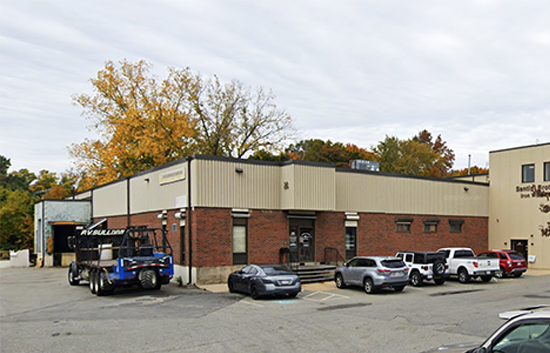 28 Sycamore Ave, Medford